Book//mark – The Road to Oxiana | Robert Byron, 1937
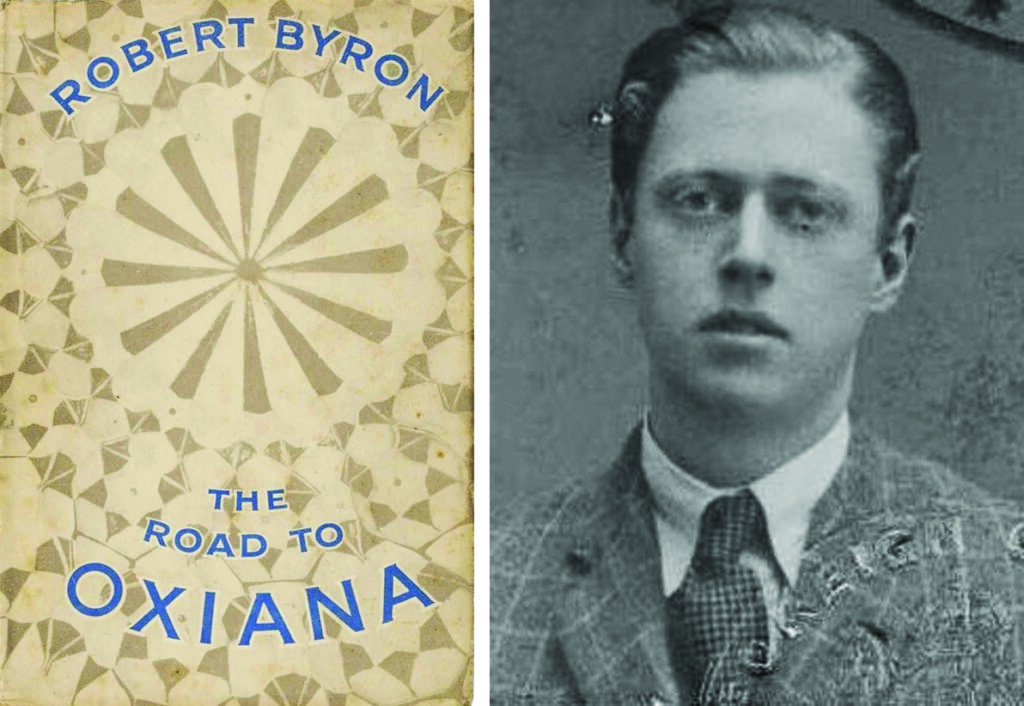
Robert Byron, The Road to Oxiana, 1937 / Robert Byron, 1923
“The beauty of Isfahan steals on the mind unawares. You drive about, under avenues of white tree-trunks and canopies of shining twigs; past domes of turquoise and spring yellow in a sky of liquid violet-blue, along the river patched with twisting shoals, catching that blue in its muddy silver, and lined with feather groves where the sap calls; across bridges of pale toffee brick, tier on tier of arches breaking into piled pavilions; overlooked by lilac mountains, by the Kuh-i-Sufi shaped like Punch’s hump and by other ranges receding to a line of snowy surf; and before you know how, Isfahan has become indelible, has insinuated its image into that gallery of places which everyone privately treasures.”
”Baalbek is the triumph of stone; of lapidary magnificence on a scale whose language, being still the language of the eye, dwarfs New York into a home of ants. The stone is peach-coloured, and is marked in ruddy gold as the columns of St. Martin-in-the-fields are marked in soot. It has a marmoreal texture, not transparent, but faintly powdered, like bloom on a plum.
Dawn is the time to see it, to look up at the Six Columns, when peach-gold and blue air shine with equal radiance, and even the empty bases that uphold no columns have a living, sunblest identity against the violet deeps of the firmament.
Look up, look up; up this quarried flesh, these thrice-enormous shafts, to the broken capitals and the cornice as big as a house, all floating in the blue. Look over the walls, to the green groves of white-stemmed poplars; and over them to the distant Lebanon, a shimmer of mauve and blue and gold and rose. Look along the mountains to the void: the desert, that stony, empty sea. Drink the high air. Stroke the stone with your own soft hands. Say goodbye to the West if you own it. And then turn, tourist, to the East.”
“A man looking like a decayed railway porter–as most Persians do under the present sumptuary laws–joined us at the mosque. We dined with a man named Hannibal, who is descended, like Pushkin, from the Peter the Great’s negro and is certainly cousin to certain British royalties. Also present was a Jewish revisionist leader, part of an extreme party that wants England to set up a Jewish state. I don’t know how long they think the Arabs would suffer a single Jew to exist once the English went.”
“They [the Jews] are pouring in. Last year permission was granted for 6,000: 17,000 arrived, the extra 11,000 by frontiers which cannot be guarded. Once in Palestine, they throw away their passports, and so can’t be deported.”
“Suddenly, as a ship leaves an estuary, we came out onto the steppe: a dazzling open sea of green. I never saw the colour before. In other greens, of emerald, jade, or malachite, the harsh deep green of the Bengal jungle, the salad green of Mediterranean vineyards, the heavy full-blown green of English summer beeches, some element of blue or yellow predominates over the others. This was the pure essence of green, indissoluble, the colour of life itself.”
“I have never encountered splendour of this kind before. Other interiors came into my mind as I stood there, to compare it with: Versailles, or the porcelain rooms at Schönbrunn, or the Doge’s Palace, or St Peter’s. All are rich; but none so rich. Their richness is three-dimensional; it is attended by all the effort of shadow: In the Mosque of Sheikh Lutfullah, it is a richness of light and surface, of pattern and colour only. The architectural form is unimportant. It is not smothered, as in rococo; it is simply the instrument of a spectacle, as earth is the instrument of a garden. And then I suddenly thought of that unfortunate species, modern interior decorators, who imagine they can make a restaurant, or a cinema, or a plutocrat’s drawing-room look rich if given money enough for gold leaf and looking-glass. They little know what amateurs they are. Nor, alas, do their clients”
“Fields of opium poppies surrounded the infrequent villages shining their fresh green leaves against the storm-inked sky. Purple lightning danced on the horizon. It had rained here already, and out in the desert we could smell the aromatic camel-thorn as if it was on fire. Yellow lupins mingled with big clumps of mauve and white iris. Kariz itself was pervaded by an overpowering scent, as sweet as bean-flowers, but more languid, more poetic. I walked out to try and place it. The opium flowers called me, glowing in the dusk like lamps of ice.”
“While the cadent sun throws lurid copper streaks across the sand-blown sky, all the birds in Persia have gathered for a last chorus. Slowly, the darkness brings silence, and they settle themselves to sleep with diminishing flutterings, as of a child arranging its bedclothes. And then another note begins, a hot metallic blue note, timidly at first, gaining courage, throbbing without cease, until, as if the second violins had crept into action, it becomes two notes, now this, now that, and is answered from the other side of the pool by a third. Mahun is famous for its nightingales. But for my part I celebrate the frogs.”
Robert Byron, The Road to Oxiana, 1937
Robert Byron was a prominent member of the “Bright Young Things,” a group of decadent, aristocratic London socialites famous for hedonistic parties and elaborate pranks in the 1920s, though he was also a serious art historian and travel writer whose fame peaked with works like The Road to Oxiana, and he tragically died at sea in 1941 while on wartime service.
The Road to Oxiana is a travelogue by the explorer Robert Byron, first published in 1937. It documents Byron’s travels around Persia and Afghanistan, and is considered one of the most influential travel books of the 1930s.
Also:
Bright Young People : Actress, Αddict & ”It Girl” | Brenda Dean Paul, 1907-59
Bright Young People: Silver Society | Photos by Curtis Moffat, 1923-35