Persons [ ] To make Music means to Express Human Intelligence by Sonic Means | Iannis Xenakis, 1922-2001
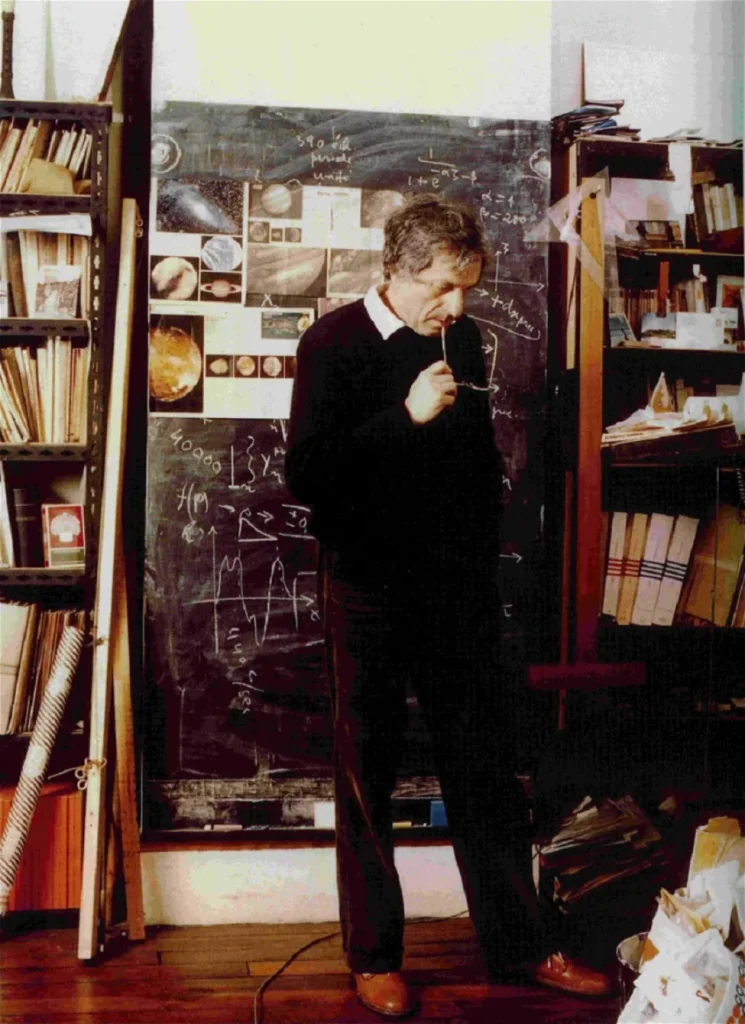
Iannis Xenakis
“The sub-structure of music is much closer to the sub-structure of space and time. Music is purer, much closer to the categories of the mind.”
“The listener must be gripped and whether he likes it or not, drawn into the flight path of the sounds without special training being necessary. The sensual shock must be just as forceful as when one hears a clap of thunder or looks into a bottomless abyss.”
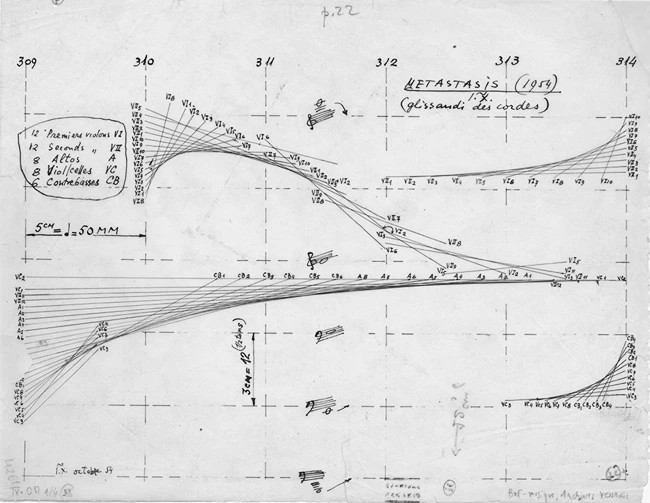
Iannis Xenakis, Metastasis, 1953–4
“To make music means to express human intelligence by sonic means. This is intelligence in its broadest sense, which includes not only the peregrinations of pure logic but also the “logic” of emotions and intuition. My musical techniques, although often rigorous in their internal structure, leave many openings through which the most complex and mysterious factors of the intelligence may penetrate.”
Iannis Xenakis – Herma – 1961 · Martin von der Heydt
“The most difficult piano piece ever written”
Susan Bradshaw
“That comes from inside. I have no idea. There are many years that I am writing music and I do not know why. I started writing music very late. I was over twenty already, and it was a good motivation to exist. I was trying to do something different also. Otherwise, you do not exist.” *
“Music is not a language. Any musical piece is akin to a boulder with complex forms, with striations and engraved designs atop and within, which men can decipher in a thousand different ways without ever finding the right answer or the best one.”
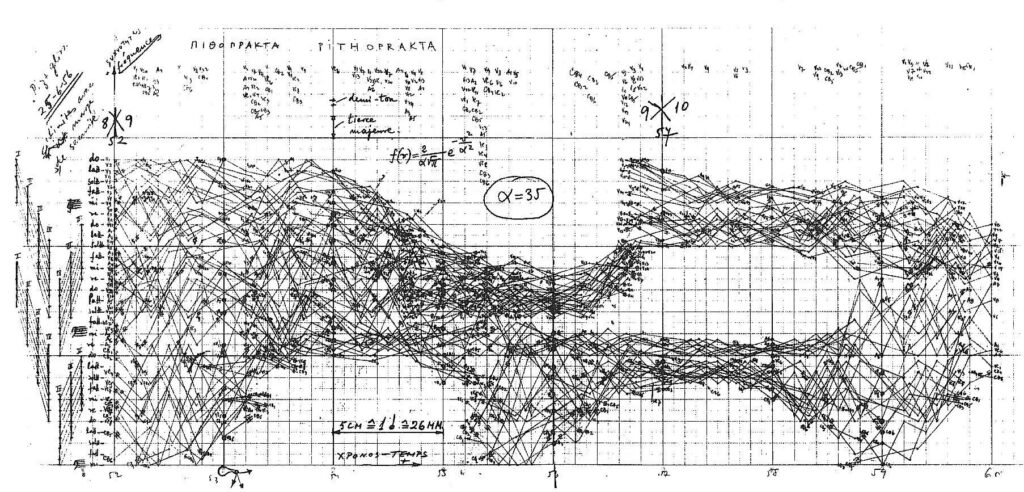
Iannis Xenakis, Pithoprakta, 1955-6
“When I woke up on the morning of the 1st August 1964 I suddenly became aware of the fact that I had dreamed the complete course of a piece of music, and to an incredibly detailed degree. I was still able to remember all the particulars, above all – naturally – the fact that the two cellists were placed near the front of the platform on either side, with the percussion player between them as “umpire”. The details of performance, with the types of sound, methods of articulation and gesticulation, and above all the markedly “sporting” character of the piece, remained in my mind with the utmost clarity. At that time I was working on a composition for entirely different forces and with a totally different disposition of the material; I could see no relationship, as regards either content or form, between the sound world of the two concepts. I did not want to give up work on the piece on which I was already engaged in order to bring a dream to realization. Nine nights later, however, the dream performance was repeated, with the same clarity of detail as before. I was perturbed, this time I made notes, and tried to define the elusive time element of the imaginary music in terms of concrete tempi. On the following morning I realized that the dream had been repeated yet again. This time I laid everything aside, in the belief that fate had knocked three times, and that it was high time to do what was required of me. – I wrote this Match in sound within seven days. The dream has never again been repeated, which is a pity, because I should like to compare it to the finished score.” ^
Iannis Xenakis – Nomos Alpha, for solo cello – 1965 · Garth Knox
“Art, and above all, music has a fundamental function, which is to catalyze the sublimation that it can bring about through all means of expression. It must aim through fixations which are landmarks to draw towards a total exaltation in which the individual mingles, losing his consciousness in a truth immediate, rare, enormous, and perfect. If a work
of art succeeds in this undertaking even for a single moment, it attains its goal. This tremendous truth is not made of objects, emotions, or sensations; it is beyond these, as Beethoven’s Seventh Symphony is beyond music. This is why art can lead to realms that religion still occupies for some people.” ^
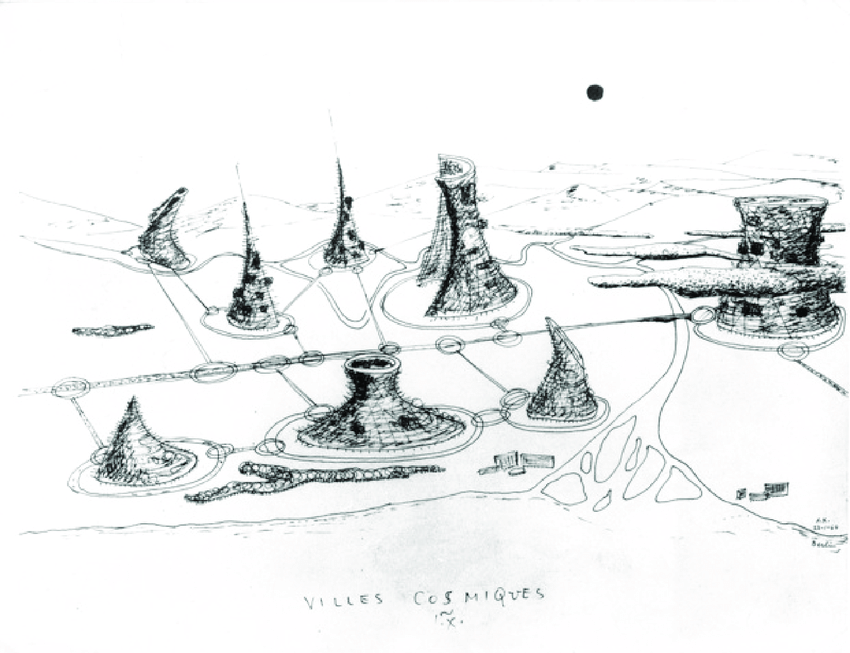
Iannis Xenakis, Cosmic City, 1963-4
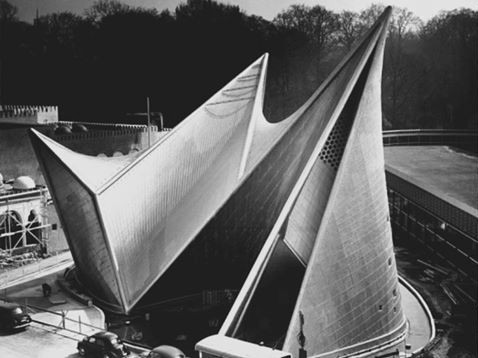
Iannis Xenakis, Philips Pavilion, 1958 Brussels World’s Fair
“When I was with Le Corbusier I designed buildings that were not too complicated, but he accepted them. For instance, the Monastery of La Tourette. I did all the plans including windows with vertical separations.” *
“I think that the music that I write is not important for most of the people. It is like an island. Sometimes very few people like it and other people no, but it takes time. So maybe after my death they will be more interested in what I have done during my life. But that is not a problem because I cannot do anything else.” *
Iannis Xenakis – Polytope de Cluny – 1971
“I write pieces which are difficult for the musicians to perform sometimes; also for the conductor, but who cares.” *
“Sometimes the conductors and the orchestra discover things in what I have written — more than just the pitches — but sometimes they do not do that. They are prone to, how do you call that, inertia.” *
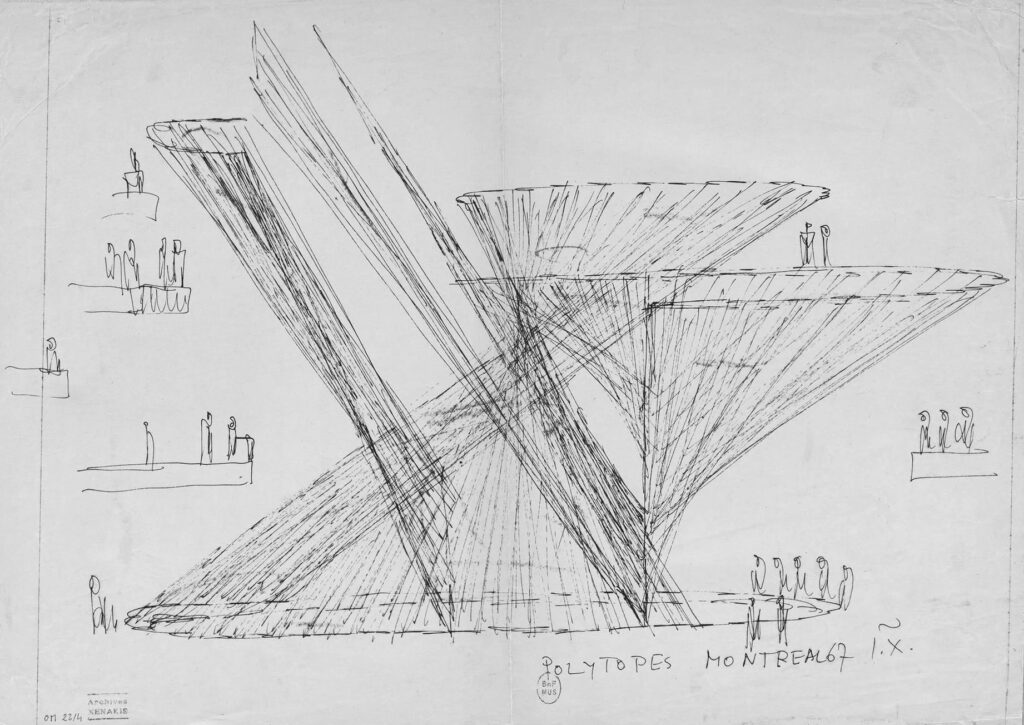
Iannis Xenakis, Polytope de Montréal, 1967
“Let us imagine a competitive situation between two orchestras, each having one conductor. Each of the conductors directs sonic operations against the operations of the other. Each operation represents a move or a tactic and the encounter between two moves has a numerical and/or a qualitative value which benefits one and harms the other. This value is written in a grid or matrix at the intersection of the row corresponding to move i of conductor A and the column corresponding to move j of conductor B. This is the partial score ij, representing the payment one conductor gives the other. This game, a duel, is defined as a two-person zero-sum game.” ^
Iannis Xenakis – Kraanerg – 1968 · Ensemble Ars Nova
“The musical scale is a convention which circumscribes the area of potentiality and permits construction within those limits in its own particular symmetry.”
“The collision of hail or rain with hard surfaces, or the song of cicadas in a summer field. These sonic events are made out of thousands of isolated sounds; this multitude of sounds, seen as totality, is a new sonic event.”
“Do you realize that we’re meteorites; almost as soon as we’re born, we have to disappear?”
Iannis Xenakis, 1922-2001
^ Formalized Music: Thought and Mathematics in Composition, 1963-71
* Conversation w Bruce Duffie, 3, 25, 1997
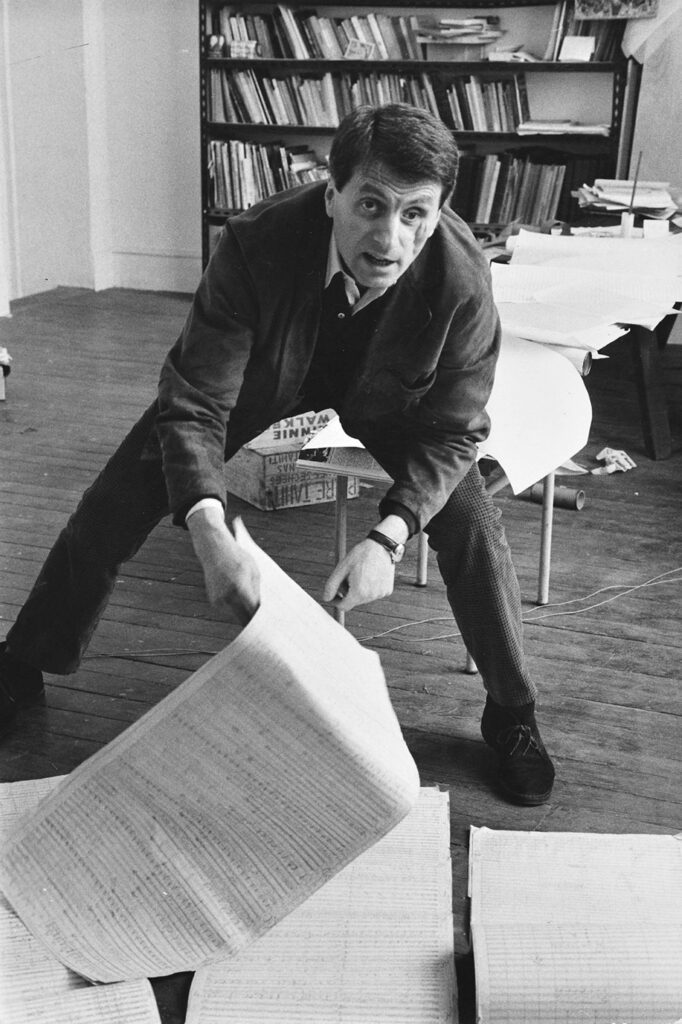
Sabine Weiss, Iannis Xenakis, Paris, 1968

Iannis Xenakis, Athens, 1944