On [:] Death Ritual | Mikhail Bakhtin, 1963
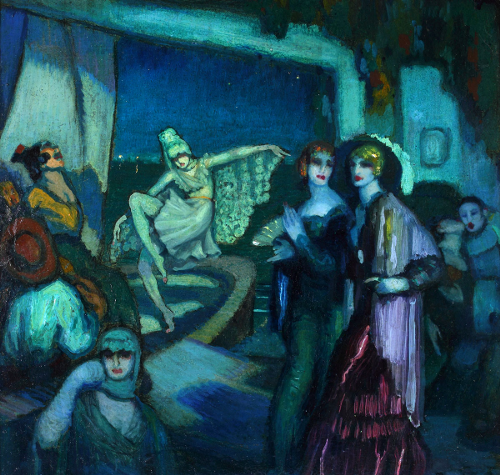
Federico Beltrán Masses, Carnival, 1925
“Deeply ambivalent also is the image of fire in carnival. It is a fire that simultaneously destroys and renews the world. In European carnivals there was almost always a special structure (usually a vehicle adorned with all possible sorts of gaudy carnival trash) called “hell,” and at the close of carnival this “hell” was triumphantly set on fire (sometimes this carnival “hell” was ambivalently linked with a horn of plenty). Characteristic is the ritual of “moccoli” in Roman carnival: each participant in the carnival carried a lighted candle (“a candle stub”), and each tried to put out another’s candle with the cry “Sia ammazzato!” (“Death to thee!”). In his famous description of Roman carnival (in Italienische Reise)h Goethe, striving to uncover the deeper meaning behind carnival images, relates a profoundly symbolic little scene: during “moccoli” a boy puts out his father’s candle with the cheerful carnival cry: “Sia ammazzato il Signore Padre!” [that is, “death to thee, Signor Father!”]”
Mikhail Bakhtin, Problems of Dostoevsky’s Poetics, 1963
Also:
Instant Views [o.] Carnival | Nikos Economopoulos, Peloponnese, Krokees (1988-1989)
On [:] Time | Lewis Carroll, 1865
Carnival | Paintings by Jose Gutierrez Solana (1886-1947)